Thursday, 16 April 2015

Evaluation Activity 4: Equipment Overview

This is the camera we used to film our trailer, a GoPro Hero 3+. We were very happy with this cameras quality as it shot in 1080p and also had several other functions we used to our advantage, such as the wide angle lens that caught everything in the background of each shot. It also did an excellent job at picking up sound, resulting in a very professional looking trailer.
This is the jacket that our antagonist used as a costume in our trailer. We chose this jacket as it was entirely black and had a hood. Black was important to make our character seem threatening and to tie symbolic codes of darkness to our villain. The hood was important to raise enigma codes surrounding the characters identity.
This was one of the most important props of our trailer; our killers kitchen knife. We drew focus to it near the beginning of our trailer when our killer is cleaning the knife of his victims blood and toward the end of the trailer when he is walking around our protagonists house. It was important to make sure the audience were aware of this prop as without it the threat and fear factor of our villain significantly decreases.
This is the TV we use in our trailer. In the first scene set in our protagonists house it is the TV that shows our news report on the escaped killer to our lead actresses. To show our filmed news report on the TV we had to upload the footage on to youtube and then access youtube through the TV. We were lucky that the TV was a new one that had such technology on it. It was relatively simple to set up and proved to be very effective in our final trailer.

Evaluation Activity 3: Audience Feedback


This is our audience response.

Strengths that were pointed out to us in the response were the various different camera angles we used throughout the trailer, especially the CCTV camera we used were effective in showing various different perspectives. We were also told that all the small diegetic sounds that we used were effective in making the trailer seem realistic which drew the audience in. The tense music we used was also believed to be a strength because it kept the audience on edge throughout the trailer, the static we also used was able to effectively break up the shots in-between the CCTV shots. Another strength was the fact that the antagonist was wearing all black, which helps him conform to what an audience would expect him to wear. The setting was also another strength as the house setting allowed the audience to relate to the events in the film, which makes it appear more scary to the audience, our titles were also used effectively as it links into the increasing strength of the storm. The faded transitions we used between most shots helped create tension, and the link between the scenes and the music was effective.

The weaknesses from our trailer were also pointed out to us, such as the fact that the camera was at times wobbling gently in the trailer this degraded the quality of the trailer. When it came to sound we were told the static transition was way too loud and there was some interference from the background in our news report.

Evaluation Task 2: Directors Commentary

Actors Interviews

Screenshot Evaluation 9: Special Effects


This shot shows our antagonist just after killing his first victim. It is a high-angled long shot which shows the character walking down a path, away from the scene of the crime. We put a black and white filter on the footage as a special effect to give the effect of the events being captured by a CCTV camera. This shows the audience how their lack of information on the characters identity and motivation is evident in the world of the film as well, with the CCTV footage obtained also unable to offer any new clues to anyone reviewing it.

The lack of colour in this shot matches the dark nature of the story at this stage, with a random innocent person having just been murdered by our killer. The overgrown bushes, dirty river and grime on the bridge also fits with the tone of the scene. We subvert a convention of most horror films with this shot by showing our antagonist in a high-angled shot. This could suggest a vulnerability in our villain but could also serve to create more tension among the audience by placing them in a position of power after our killer has claimed his first victim.

Wednesday, 15 April 2015

Screenshot Evaluation 8: How Characters are Introduced


This shot is from the part of our trailer where our villain stalks and kills his first victim. This is the clearest shot of the antagonist that the audience gets in the trailer, without giving too much away about his identity. We set this shot up carefully so that the lighting meant the characters face was not visible and that he still came across as more of a silhouette  to the audience. We show him cleaning blood off of his knife nonchalantly, giving the audience a good idea of the cold hearted nature of the character as well as his murderous intent.

The location of the shot, with the overgrown bushes and dark pathways under bridges is meant to give an idea of the characters hiding away from normal civilisation and lurking in the untouched corners. The character is also surrounded by stinging nettles, carrying the symbolic code of pain and suffering which the audience should associate with the character.

Screenshot Evaluation 7: Genre and how trailer suggests it


This shot is from the final act of our trailer, showing our 2 main protagonists watching our news broadcast at home before the killer turns up and switches the lights off. We set this shot up so the focal point of both the audience and our characters (the TV) was in the centre of the shot. This makes it more significant when the TV suddenly switches off, signalling the arrival of the antagonist.

This is the shot in our trailer that is most suggestive of the trailers genre by including several conventions. One of these conventions would be the 2 female characters who act as 'damsel in distress,' in the film purely as victims for our villain to hunt. Having female protagonists has become a convention of horror films as it attracts both female audience members and male audience members according to Laura Mulvey's 'Male Gaze' theory. The second convention would be the diegetic sound of a knife being sharpened off-screen. The third convention is the power cut/ all lights being turned off by the antagonist to create fear. The final convention that ends our trailer would be the scream from one of our female characters. From all of these the audience cannot mistake our trailer as being anything other than a horror film.

Screenshot Evaluation 6: Story and how the trailer sets it up


This shot is from the introductory news broadcast that sets up the story of our film. We filmed this on a road between Leatherhead and Fetcham that was relatively quiet, which aided filming. We set the shot up in the same manner that we saw real news stories set up, with the reporter on the right-hand side of the screen and a location relative to the story taking up the background on the left-hand side. We made sure our reporter was dressed appropriately too add to the realism. We chose this location as it looked like an abandoned structure, covered in moss and with litter strewn across the floor. We thought this would look good as the asylum in our story that our antagonist escapes from as it looks generally creepy and would not be somewhere you would want to explore further.

We use the news broadcast to relay several key points of our narrative to the audience in a quick manner without it seeming forced, which would take away from the realism of our trailer as a whole. Here, the audience finds out that there is a dangerous killer who has escaped from a mental asylum and is now on the run, with no one knowing where he is. This is also how our protagonists find out about the antagonist in the film as he enters their house, meaning the method also progresses the plot rather than just informing the audience of the story.

Screenshot Evaluation 5: Title Font & Style


We conformed to one of the main conventions of a horror film in our trailer, the use of the "based on a true story" marketing tool. This encourages audience members to see the film to find out what happened, meaning the audience views seeing the film as informing themselves as well as being entertained. This also engages the audience more as it makes the events depicted onscreen more shocking and frightening if you believe they are based in reality and not limited to the confines of cinema. 

We decided to use a basic white on black colour scheme for our title cards, making it plain and easy to read. Black also fits with the genre as it connotes darkness and unknown, having a green background would not have fit with the tone and atmosphere we were trying to create. The font we chose is Orator, an old-style typewriter font that ties in nicely with the proposition of the story being true.

Screenshot Evaluation 4: Camerawork & Editing


This screenshot comes from the 2nd act in our trailer that involves our antagonist stalking and killing his first victim. We opted to use a low-angled mid-shot to show our killers movements as this empowered the character, making him seem more powerful and threatening as he is above the audience. This also helped to show less of the character, as was our intention throughout our trailer in order to create enigma codes surrounding our antagonists identity. In other shots involving our killer we could use lighting to help mask his face but as the location we used to film the above shot was well-lit we thought we would only focus on the bottom half of the character so as not to give too much away. 

Having the bottom half of the shot show the mud and the top half the sky and the trees offers a nice juxtaposition to the shot. Having a shot composed like this with contrasting features should have a slight unsettling effect on our audience, which is why we set up many of the shots involving this character in the same fashion.

Monday, 23 March 2015

Screenshot Evaluation 3: Costumes & Props


This is a screenshot from our trailer of a tracking shot showing our killers movements through our protagonists house. We chose to keep the shot low to draw focus to the characters weapon which makes him seem more powerful, intimidating and expands the threat he imposes on our victims. This shot took several attempts to achieve as we needed to keep the camera relatively level with the villains waist whilst moving and also tracking our villains movement accurately. This meant not walking too fast so most of the shot would be taken up by the black of our characters outfit nor too slow so that he would be out of shot whenever he walked around a corner. 

We initially filmed this shot with lights on but it didn't quite look right as we still want to carry the enigma code of our villains identity so it made more sense to keep him in a low light environment to reveal as little of him as possible. This also makes the actions of the antagonist seem even more creepy as it is a fear audience can relate to, that of having someone lurking in the dark areas of your own home.

Screenshot Evaluation 2: Setting/Location


This is a still from our trailer that introduces our antagonist, having him stalk a random victim under a bridge. We filmed this shot at Leatherhead bridge as it was easy to get to and quiet, meaning we would not be disturbed by any members of the public which was important as we wanted to make it seem as if our characters were completely alone. 

We liked the long pathway that runs through the centre of the shot and the open environment as it makes it seem as if this area is further away from civilisation. This extends the threat of our antagonist and makes our victim seem more vulnerable as there is nowhere they can run to. The area itself is also quite tranquil with the river running on the right third of the shot and the trees and grass representing nature. This juxtaposes the dark nature of the events actually being depicted in the shot, an innocent person being stalked and killed by a masked murderer. Having the location differ in tone from the events the audience sees has an unsettling effect on the audience, which is exactly what we want to achieve through our trailer.

We opted to place the camera under the bridge filming outwards, as this achieved our desired lighting effect. In this shot, we have our victim and villain walking towards the bridge from the outside, with our victim walking under the bridge and being plunged into darkness. Having our victim walk from the light to the dark connotes walking into the unknown and shows the character unknowingly putting himself in danger.

This shot is a high-angled long shot. We decided to use a high angle for this shot as it empowers the audience over the characters. This fits with what the audience sees onscreen as they are aware of the threat our killer imposes but the victim is completely unaware. Therefore we are making the audience feel safer only to surprise them later in the trailer. In later shots that only feature our antagonist we revert to the conventional low-angled shot to belittle the audience and empower our villain.

Wednesday, 18 March 2015

Screenshot Evaluation 1: The Title of the Film


This is a screenshot of the title of our film in our trailer. We chose to put the title along with thunder and lightning in the background in order to give the title an air of power and importance to the audience like the name alone should command their respect. This amplifies the audiences desire to see the film if they think it is important that they see it. This also has the effect of foreshadowing dark events taking place in the film, representing the dark tone that our murderous antagonist brings through his actions. These titles come straight after our female protagonists screaming after the lights go out, meaning the lightning is suggestive that the result of that event is negative but the audience will still want to see the film to find out what happened.

We chose a white font for the title itself in order to make the title stand out from the rest of the shot which is mostly black. It was important to make the title distinctive so the audience knows the name of the film which will help them recognise it in cinemas and allow for word-of-mouth promotion, which wouldn't happen if the audience didn't even know the title of the film. The colour white also connotes innocence, purity and vulnerability and carries a symbolic code of heaven which juxtaposes nicely with the evil-and-hell-linked lightning. Inspirations for this come from Se7en, The Sixth Sense and The Blair Witch Project, all of which also opt for a white font set against a dark background.

Wednesday, 4 March 2015

Trailer Conventions Analysis

One convention of a film trailer is to have the title of the film appear at the end of the trailer. This is done to make the title a focal point of the trailer, as if it is the last thing the audience sees it is likely to be the thing they best remember. Making the title a focal point for the audience is very important as if they don't know what the film is called it is less likely they are going to find and see it because they won't recognise it by name. We conformed to this convention in our trailer for the same reason, as we want the name stalker to stick in the audiences memory. I think this is even more important for a film such as ours as the title tells the audience a key part of the film, that the antagonist is a stalker. Without drawing attention to our title the audience may misinterpret the character to be a typical murderer as there is no other reference to stalking in our trailer apart from the title. We want the audience to know our antagonist is a stalker as it gives a bit more detail to the characters motives and makes him a bit more 3-dimensional, as if they do not know anything about his motives as well as not knowing who he is or what he looks like they may not be interested in the most important character in our film, and therefore the film itself. The titles we have created are also important at highlighting the tone of the film, as our title is linked with darkness, thunder and lightning which we think leaves the audience with a foreshadowing of what happens in the film and carries significant symbolism along with it.

Trailers often give the audience more information through voice overs and titles throughout the trailer that help to paint a better picture of the film that may be hard to represent through showcasing certain scenes. The typical example of a voice over would be Don LaFontaines work on nearly every action movie trailer ever including Die Hard, Lethal Weapon and Rambo. We opted not to use a voice over in our trailer due to it being a horror, as we felt the inclusion of a voice over would remove the audience from the suspenseful atmosphere we were trying to create. A voice over isn't part of the film and instead is made in post-production and therefore serves as a reminder that what the audience is watching isn't real, making it harder to have them fully invest in the characters. On the other hand we did decide to use a title card towards the beginning of the trailer that says "based on a true story." This is a statement most horror films like to make whether true or not, as it makes the audience want to see the film more if they think that all the crazy events depicted on screen happened in real life. Whilst not part of the film, this title card works to draw people in to the world the film is creating as it gives it an edge of realism, as opposed to reminding the audience that it is only a film designed to entertain.

Another commonly used aspect of a trailer is the montage, where a series of shots are shown in quick succession in order to highlight some of the key moments in the film without giving too much away. This also has the side-effect of raising the tempo of the trailer and making it seem more dramatic as it builds to its climax at the end. We chose to subvert this convention for our trailer as we feel that ending the trailer on a high tempo with a big climax is better suited to an action film that is working to get its audience pumped up in anticipation of seeing the film. We felt it was more important to have our trailer create a low tempo with high tension to match the genre. Suspense is created from longer shots as it gives the audience time to digest exactly what is happening onscreen and anticipate what is going to happen next, allowing for a bigger 'jump-scare' so we chose to match this slower pace in our trailer. Our trailer has a clear 3 act structure taken from 3 key scenes of our film, not giving too much away to our audience in order for clear enigmas to be left hanging that encourage the audience to see the film.

The most influential inspiration in the making of our trailer would have been director James Wan. He is known for his work on a lot of modern horror films including Saw, Insidious, Insidious: Chapter 2 and The Conjuring. Insidious is particularly well directed in its use of long, lingering shots that hold the audience on the edge of their seats and we sought to recreate the same technique in shooting our trailer. All of the James Wan films mentioned above also share something in common in terms of location, with them all being predominantly set inside a single room or house. This gives off the idea of being in a confined space, away from civilisation and trapped with the antagonist. We chose to employ this method with our trailer as well with most of the film taking place inside the protagonists house.

Audience Theory

My film "Stalker" is a horror film and it utilises many conventions from the horror genre in order to convey this to the audience. For example, my film includes a masked, mysterious antagonist that is hardly shown in my trailer in order to raise tension and enigmas in the audience. This is a clichè adopted by many films because it is so effective at enhancing the fear factor of the film as it plays on audience fears of the unknown. Specific examples include The Collector, Saw and Predator. The Hypodermic Needle Theory states that the audience is a passive mass who will immediately accept the version of events presented to them. Applying The Hypodermic Needle Theory to my film, it would mean the audience instantly believing that there is an escaped asylum patient that goes around stalking/killing people and that it could happen to them, further increasing the scariness of the film. The vast majority of horror films are rated 18 because the messages they are conveying are considered to frightening for a younger audience. Due to this, my film is rated 18 also as it contains certain messages which may be unsuitable for children, such as an escaped lunatic going on a murderous rampage.

The Uses and Gratifications theory was popularised by Katz and Blumler, and works as a way of explaining what the audience uses media for as opposed to what the media does to the audience. The theory states that there are 4 main reasons why someone would want to use media; diversion, information, social interaction and personal identity. I believe the audience would want to see my film for the diversion (immersing yourself into media to be entertained and as an escape from their normal lives) and social interaction (so they can talk about the new horror film with their friends and family and not be 'out of the loop') elements. You could also say my film satisfied the simple need from the audience to be entertained through my use of creating enigmas and suspense for the audience.

George Gerbners Cultivation theory states that the longer the audience spends in the world of media the more they believe that what they see is applicable to the real world. For example, the more crime films an audience member watches the more they will believe the world is a violent place and that crimes like the ones they see in the films can be happening round the corner. With my film, Cultivation Theory would believe that it would help to further the audiences fears of being killed or heighten their fears of the unknown as they are both elements my film plays on in order to entertain. The violence-related content contained in my film would link with the 'Mean-World Syndrome' that Gerbner mentions in his theory.

Laura Mulvey coined the phrase "male gaze" in 1975 to describe her theory that films are shot from a heterosexual male perspective and that women are often reduced to objects to be gazed upon in films. She also believes that women need to watch films from the male perspective as events depicted on screen are filmed in the context of a mans reaction to these events. It can be argued that my trailer does conform to the theory of the male gaze, mostly due to the fact that my trailer doesn't flesh out our female characters personalities enough even though they are meant to be the main protagonists/victims of our stalker. Instead they are slightly objectified, only shown screaming and with one line of dialogue between them making it obvious to the audience that they are simply cannon fodder for our film. You could say that this was a consequence of having to prioritise what was shown in the trailer, as with a film called Stalker you want the stalker to be on screen as much as possible in the trailer as that is what will draw audiences in, not finding out what the protagonists pets are called or what jobs they have. So whilst they may seem relatively monotonous for horror victims in our trailer their characters would have been expanded upon in our film so that the audience has characters to sympathise with and root for rather than just people to watch get murdered.

The Utopian Solutions Theory comes from Richard Dyer, and states that audiences consume media to fill the inadequacies in their own lives. Films would therefore gain the best response from an audience member if it provided them solutions to multiple inadequacies. For example, a film like Wolf of Wolf Street is successful because it provides the solution of abundance to audience members problem of poverty. Audience members who feel their lives are boring will enjoy The Expendables because it contrasts to their real-world problem with exciting action-packed plots. Many sit-coms become popular because it provides community to people who feel isolated. My trailer would provide a solution to people who feel their lives are mundane. Audiences would watch my film and they would enjoy the contrast between their own lives and running for your life from a knife-wielding maniac. You could also say that a film in the horror genre, such as mine, almost reverses the Utopian Solutions Theory, as the audience takes enjoyment from watching characters with inadequacies and problems whilst the audience themselves is likely to already have the solution of safety.

Thursday, 12 February 2015

Finished Trailer


This is our final trailer. As seen from the trailer we have multiple production companies to show our company is well funded and our trailer is well made. The reporter acts as a kind of narrator and sets the context for the trailer, despite being in the film, the low angle used by the camera gives the news reporter power over the audience and it makes him appear as the most important character in the scene. The text on screen "based on a true story" is powerful because it makes the audience believe what is about to happen onscreen really did take place in reality. The two girls watching the news report adds context to the early footage, while also setting the scene for some other clips later in the trailer. It also makes the scene seem very mundane and normalised, most people would watch TV at night and this could relate to the audience. The scene with the antagonist in it is taken from two perspectives; the first is a high angle shot as the 'victim' is seen walking past, the second is the low angle shot as the antagonist walks past. This gives the audience power over the victim, and we lose that power to the antagonist as he follows on behind, this can make the audience feel intimidated as we now feel small. The cut to black and white shows CCTV footage of the same incident, this is why we used the transition. The antagonist can be seen holding a knife in the next scene, this threatens the audience and it also indicates there is murder and probably gore along with it. We then cut to a different scene in a house. The antagonist is clearly seen from a birds eye view, this adds tension amongst the audience, as we can see him clearly but we can't do anything to stop him. The clear shot of the knife adds danger and the possibility of death as we would expect from a thriller. As the lights go out and we hear the scream, the audience could become unsettled because we don't see what is going on and at this point we can only assume what happened. The film title then appears along with thunder and lightning, this adds to the tension and also fits with the night time perspective of the final scene. The music in the background adds tension to the whole trailer and this eventually builds up to the final scene.

Evaluation: Our trailer is very conventional in terms of what an audience would expect from a trailer, as our trailer shows the main characters and the main points of the film. We have also implemented several different camera angles throughout the trailer to show dramatic scenes between characters. Between clips we also found it useful to spread out the credits along with some background and dramatic text on screen, this is also aided by the creepy music in the background that helps to build up tension in the trailer and helps build up to the final showcase for the film where the lights cut out and the audience hears a scream. In our trailer we made the decision to leave our film titles till the end, this helps draw the audience in and makes them want to see what the film title is so they can go and see it. As pointed out earlier our trailer builds to a climax, and like with other trailers where they will show one of the most scariest or most exciting clips we decided to end our trailer with a cut to black, as the audience won't know whats going on and this could make them want to see the rest of the film. Overall our trailer does use a montage of clips to showcase the most exciting parts of our film, this is intended to draw the audience in and make them excited or scared to see our film.

I believe that the trailer we have produced has been generic, however it has featured several experimental ideas, as well as challenging some of the conventions we would expect to see in a trailer. Firstly our trailer is generic to most trailers from this genre as it does adhere to several conventions, not all of them however as we did add a couple of things that we suspect might be experimental. That includes having a change in camera colour to signify a change of camera type to a CCTV camera, which of all the film trailers I have watched for this genre is a completely original change. As well as this bit of experimenting we also challenged some of the conventions of trailers by not including some things that are generally included such as specific speech like one liners from the characters, we use very little to dialogue in our trailer. This is because we want to use the sound and the images on screen to the maximum and we felt that dialogue would ruin the atmosphere being built up, this is also why we had the reporter at the start of the film to give some background but that is really it.


The trailer we have developed has changed over time, as we were at first not doing this kind of horror/thriller, we intended to make a trailer like paranormal activity, however due to restraints we were unable to pursue this idea. We have mostly been influenced by directors such as Alfred Hitchcock, who is probably the most famous thriller/horror director, he was important because he used music very well in his films especially the classic shower scene in his 1960 film Psycho, we wanted to use that kind of music to that effect, to dramatically build tension.

Animatic Storyboard


This is the animatic storyboard that we have created for our trailer.

Magazine Cover Analysis #5


This is a cover from magazine Total Film that promotes the 2008 action film Max Payne, based off of the video game series of the same name. The cover shows the main character standing with 2 guns pointed towards the reader and a serious expression on his face. Making the character prominent by centralising him in a close-up shot highlights to the audience who Max Payne is for those unfamiliar with the series and also shows off the films high-profile actor of Mark Wahlberg to attract more people to the film. The characters costume is all-black, from which readers can connote that the characters line of work is not above board i.e he works in the shadows (spy, assassin etc.).

The guns show that the film has action in it with the fact that the character is wielding a gun in each hand rather than just one emphasising the films slightly over-the-top style and excessive violence. Focus is brought to the guns through their overlapping of the magazines title and the 3D 'jumping-out-of-the-page' effect that the cover creates by having the guns come further out of the page than the edge of the cover. The characters expression helps to seperate the film from the comedy genre and firmly into the action genre as it is clear the character is intended to be taken seriously.

The background of the cover is of a dark, grey, concrete city scene that gives a rough idea of the films setting and atmosphere, a sunny beach scene would give the film a completely different tone for the audience to expect. This is reinforced with the dark clouds in the poster that could act as a foreshadowing of the gloomy events in the film. The effect of snow around the character could also be meant to represent the 'cold' atmosphere that the film is trying to create.

The title is shown in big, bold, white letters that stand out from the character so the readers are aware of the films title and the characters name. The font has a shatter effect that makes it look like broken glass which also alludes to violence and damage, so the audience know to expect this in the film.

Magazine Cover Analysis #4


This is a magazine cover from Total Film for the 2005 film King Kong. The cover image is of the films 2 main leads, the man with his arms around the woman as if protecting her from something unseen to the audience. The characters positioning is telling for the audience, the man protecting the woman reinforcing the gender stereotype of woman acting as the "damsel in distress" with the man being the brave hero. The characters costumes also tell the audience that the film is set in the past rather than modern-day as they are clothes you would expect from the 1930's rather than 2015. Having the female character dressed in all-white connotes vulnerability and innocence and tells the audience she is a protagonist rather than the films villain, although anyone with even a passing knowledge of films should be fully aware who the villain is in a film called King Kong. The mans costume juxtaposes the woman's being dark in colour, reinforcing the idea of his character being brave as he stands out more and does not wear any vulnerable white colours. This would be why the image used shows the characters in a long-shot rather than a close-up to show their costumes to the audience in order to give extra information about the film.

The background of the cover is typically dark and mysterious, drawing focus to the characters rather than the setting. If the audience looks closely enough they can make out the characters are standing in some sort of cave, alluding to the films exotic setting but not giving too much information away. The lack of any clues as to how the iconic King Kong character will look in the film is intentional, and something that most of the films promotional campaign excluded as well. This raises enigmas and makes the audience want to watch the film to see the giant ape. This films main USP would be the fact that it is a modern reboot of a classic monster film, allowing for better CGI and visual effects to create a more realistic monster, therefore not giving away that part of the film works to entice audience members to go and see the film to find out.

The text used for the film is large, capitalised and boldened, drawing comparisons with the magnitude of the films antagonist and drawing attention of readers to the film. The use of yellow on the cover for the article titles and the King Kong title stands out against the mainly black background to again, draw readers attention and make the magazine stand out in shops against other magazines.

Character Photos


These are 2 photos we took of our antagonist to use in promotional material like our film poster and magazine cover. We took the pictures in a cupboard at school so that no natural light would interfere with the pictures and the camera would only pick up what we used the flash on. It was also easy to Photoshop these pictures and make a cut-out of our character with a background that was full of colour, rather than black like our characters costume.

Magazine Cover #2


This is our final magazine cover. We designed it on paper, then using Photoshop we used several of the unique effects available to add a menacing effect to the front cover. The audience would feel threatened by a faceless antagonist, as this doesn't allow the audience to feel for the antagonist they don't get to relate to him and in this way will feel frightened by his presence. The red colour in the title links to blood which in our trailer is threatened but not shown. The faceless antagonist anchors the text title stalker and is the main selling point of this issue of Empire. The bright colours used in the other articles helps show the audience what else is in the article as well as advertising other films. The text used is big and bold with certain words emboldened to make them stand out. The barcode and price are both located in areas where they are commonly found in real life.

The skyline and main magazine title are both big and bold at the top of the page, with the 'exclusive preview' suggesting to the audience the magazine will have articles and information that no other magazine will have and this would attract more readers, as the audience are constantly looking for something that gives them more information especially if its about something they really enjoy like films. The main title 'Empire' is a major magazine company with a large readership of about 800,000 people, this means films featured on the magazine are likely to be popular, the magazine is also well respected making film reviews important. The puffs shown on the front cover are shown big, they offer free things, this attracts a younger audience, and its bright colours draws the eye especially on a dark background. The smaller articles along the right-hand side of the cover are from recent films Nightcrawler and Gone Girl these films are both psychological thrillers which links to our film as we kind of wanted this feel to our trailer, there is a clear thriller film genre in this months issue of Empire. The 'exclusive interview' at the bottom of the magazine draws the audience to read further into the magazine as two of the movies stars are being asked questions, the audience would want to know more about these actors, so they can get to know them better and it humanises the otherwise major celebrity actors.

Evaluation Activity 1: In what ways does your media product use, develop or challenge forms and conventions of real media products?

Our magazine cover is conventional when compared to other magazine covers that we have seen from our analysis earlier in the year. The font for example is  big, bold and contrasts against the background. However the font used on the main article 'Stalker' could be considered unconventional as unlike other fonts from other magazines this one is not bold, it is written in the same font as it is on the trailer, linking the trailer to the magazine cover. It stands out because the letters are so spaced apart. Also the title itself 'Stalker' is an enigma, as the audience has no idea who the main image is of, where conventionally they would normally show the face of a character, mostly the protagonist, on our magazine cover we haven't gone with that and decided it adds mystery as well as menace to the character as the main title would suggest a threat exists and the curiosity of the audience would draw them in as they would want to learn more about the film and what it is about.


The layout for the magazine is conventional, when compared with other magazine covers such as the Skyfall and Captain America Empire Magazine covers. The layout consists of several pictures or articles surrounding a close up of a films main character in the centre, and there would also be bright colours as well as puffs and exciting language used such as 'exclusive'. These puffs are conventional and would attract the reader to purchase the magazine. Coverlines emphasise the theme of the magazine cover which in this case would be thrillers. The picture in the centre of the cover is unconventional compared to the other covers I have looked at as the background is dark and cloudy and there are several enigma's that could intrigue the audience. As a whole I believe that our magazine cover is conventional when compared to other covers, it generally doesn't change the main features you would expect to see and in a way it draws the audience further in as the unknown image and the effect of 'Stalker' adds fear to the cover but also intrigue.

Questionnaire Analysis

These results show that the majority of people we asked were between the ages of 16-20; also it shows that most of the people we asked were male. We decided to set our age certificate to 15, so the questionnaire results are still helpful to us as only 5% of the people we asked were under 15. 

When deciding our location the questionnaire results helped us massively, as we were unsure on where the film would be located. With 40% of the people saying to use a house, we decided to use that. Also we agreed with 20% of the people as we chose to film some of our shots outside near a park.

The questions on the antagonist also helped us a lot. Our group was unsure whether to make the antagonist visible or non-visible. The results of the question swayed us in favour of visible, with 65% of people saying so. Also the results of the question on antagonist characteristics helped us show what the character will be like in the trailer. In the trailer the antagonist is seen to be creepy, mentally unstable and intimidating.

When asked what their favourite horror sub-genre was the majority of people said thriller, so we decided to make our film a thriller. Before we recorded this questionnaire, we were unsure whether to do a thriller or a psychological horror.

When we asked what people's favourite film was the most popular answer was Taken. Taken's genre is a thriller, which is going to be the genre of our film, so with it being people's favourite film it shows the thriller genre is fairly popular.

The question that asked what you expect to see in a horror film helped us a lot. The main answers were murders, suspense and jump scares. In our trailer we will try to use all of these things throughout. We will try to create suspense by using creepy music; the creepy music will also link with jump scares. In the trailer the main antagonist is a serial killer so there will definitely be murder shown in our trailer.


So overall the questionnaire results were very helpful and they helped us decide many things that we were unsure about beforehand. The questionnaire helped decide the characters, the genre, the location and what happens in the film. So, carrying out this questionnaire proved to be very worthwhile.

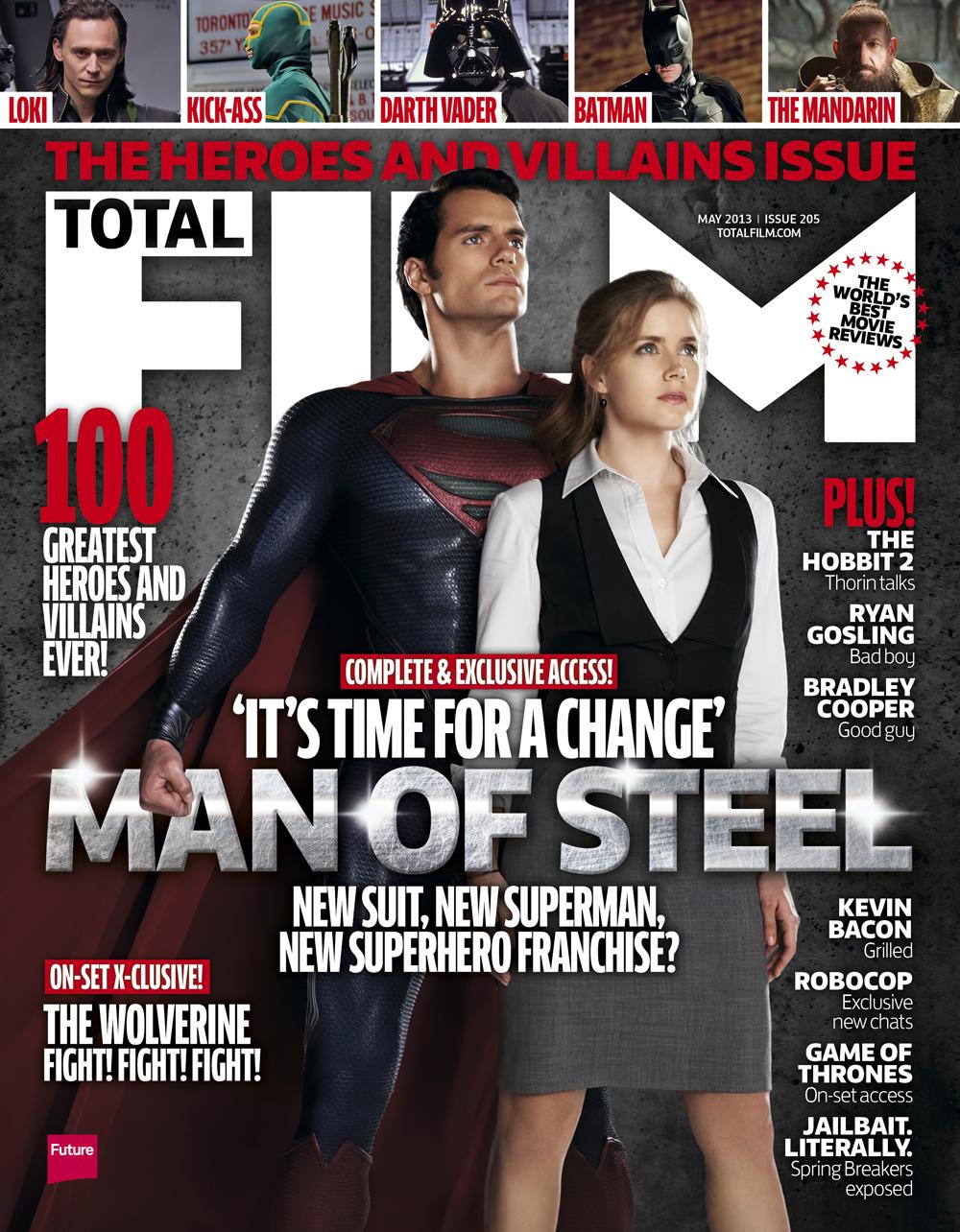
Magazine Cover Analysis #3


This is a magazine cover for Total Film magazine that shows a still from the Superman film, Man of Steel. The image used is of Superman standing in a heroic pose behind Lois Lane, his love interest from the film. The cover works to make Superman seem as powerful as possible, with his central position on the cover showing the audience his importance and the 'standing tall' pose he is in making him look masculine and strong. His position in the image, standing behind the woman shows him to be protective of her, reinforcing a "damsel in distress" stereotype that is common to the superhero genre. This is also demonstrated through his height advantage over Lois Lane which shows Superman to be the dominant character.

The iconic costume of Superman is also shown to make it obvious to the audience that this is a superman film which may not be so obvious just from reading the films name "Man of Steel." This informs the audience of the genre to draw in their target audience of superhero genre fans. In comparison, Lois Lanes costume is plain and colourless, opting for a boring palette of black, grey and white. This works to make Superman stand out as the main character but also makes Lois Lane seem to be the representation of the audience in the film i.e an ordinary person with an interest in an extraordinary person.

The magazine cover also places the characters ahead of the magazines name which highlights the films importance and makes the audience want to read about the film to see what makes it more important than the magazine itself. The characters are also set against a plain grey background, which makes the characters the audiences focus and also draws comparisons with steel and strong metal like the films name alludes to. The films name is also written in a grey text and is centralised on the cover and made bigger than the rest of the text, also making it the most prominent to readers to entice them into wanting to read the magazine.

Wednesday, 11 February 2015

Magazine Cover


This is the initial draft of our magazine cover we have created for our trailer. We used inspiration from real-life film magazines to help design our own and make it look realistic. We opted to make our antagonist the focal point of the cover as we feel that the look of the character will create enigmas for the audience and will draw attention to our film.

Friday, 6 February 2015

Film Poster


This is the film poster we have created for our trailer. We went for an overall dark tone to the poster to let the audience know the genre and atmosphere they can expect from the film. We think making the Stalker character the most prominent in the poster and surrounding the character in darkness adds an enigma of "who is the stalker?" that audiences would want to see the film to find out. The poster follows the dark, threatening theme from the trailer and magazine cover, the darkness also helps set the genre for the audience and this helps draw people in to watch the film. The main images in the poster are from the trailer or from other productions that we have produced and shows the main actors as well as the main antagonist in the most prominent image, this suggests the film will mostly be set around him. The main title to the film is set in a large font at the top of the page this gives it prominence in the poster and because it is in a white font the word stands out far better than most of the imagery. The tagline "Wherever you go, he"ll be watching" is threatening and directed at the audience, this makes it more personal and draws the reader in. The poster also has the main credits for the film which can tell the audience who produced it and who is starring in the film, this information is vital as a reader might want to know who is in the film as some people only see films if they have a certain actor or actress. As well as this the poster contains the release month and year which gives an idea of when the film will be released. We have also positioned the 'company' logo in the bottom corner, this is to tell the audience who the production company is and this can inform the reader what the film budget is.

Our film poster had initially been simply the image of the main antagonist on a black background with the film title 'stalker' at the bottom. however over time we added film credits to the bottom , this was brought in from our trailer. Along with this we added several different images to the main image, this was to show the audience the various different characters in the film . The black background we added to give the idea of what the film was about, as from this the audience can probably infer the idea that the film is a horror and maybe even a thriller. The film title has remained in the same position throughout production, we felt that most posters we had seen had their titles at the bottom, this helps draw the audience and with our title 'Stalker' it links to the main image and genre.

Tuesday, 20 January 2015

Avengers: Age of Ultron Trailer Analysis


This is a trailer for 2015 summer blockbuster Avengers: Age of Ultron. 

The opening shot of the trailer is an establishing extreme long-shot showing the skyline of a city and the surrounding areas on a summers day. A male narrator says over the shot "I'm gonna show you something beautiful..." This initial shot sets the audiences expectations up for a feel-good film, however the sharp cut to black and the following shots instantly subvert these expectations. An enigma code is created by showing a strange cloud of yellow smoke along with the narrators following line, "...everyone screaming for mercy." This makes the audience wonder what the yellow smoke is and why it would cause people to scream. The audience will also question who the narrator is and why he takes pleasure from people suffering, although it is made pretty clear that the narration comes from the antagonist. This is also a subversion from normal narration over trailers as it is commonly the protagonists viewpoint that is shown to the audience, not the antagonists. The audience are already given clues suggesting that the plot is on an international scale by the opening shot of an American looking city and the french flag held up by one of the protesting people.

The protagonists/heroes are then slowly unveiled to the audience without giving them too much screen time. One hero is shown in mid-shot from behind, the next in close-up but with a lens flare and a quick shot making it hard to make him out and another in close-up but only on the bottom half of his body and cape. This teases the audience who want to see more of the heroes, as well as the slowing pace and the scenes of destruction and chaos the characters are pictured in adding enigmas and increasing the drama. The audience is then given their first look at the antagonist in a couple of low-angled shots to make the character dominant and more threatening to the audience. The villain looks like a worn-down robot but the audience is shown his strength by how he crushes the head of another robot.

The exotic locations that are an integral part of all Superhero/Action films are then showcased in a short montage that include a castle in a mountainous area, a town in a sandy desert and a snowy forest. The montage further teases the audience of the multiple set-pieces you would expect from a film of this genre and furthers the idea of the international scale of the plot. The non-diegetic background music to this part of the trailer is interesting, as it is a slower, creepier version of the I've Got No Strings song from the kids film Pinnochio. Using a song popularised through a children's film and playing it over scenes of guns, explosions and general chaos is a heavy juxtaposition of tones and it has a largely unsettling effect on the audience. This makes them feel more uneasy about the antagonist as well. 

The trailer comes to an end on a shot of one of the most well-known props of the franchise, Captain Americas shield, torn into 2 pieces with what is supposedly Captain Americas limp hand lying next to it. This suggests that the villain is formidable and can beat the protagonists and foreshadows dark things happening in the film. This will also make the audience want to go and see the film to find out if one of the heroes actually does die or not, meaning it is an effective shot.

Ant-Man Trailer Analysis


This is a trailer for 2015 Superhero film Ant-Man.

The opening shot of the trailer is an establishing shot of San Fransisco, instantly informing the audience of where the film is set and conforming to the convention of Superhero films to be set in America. The rough plot is given to the audience through a man shown making a speech who is shown to be in some position of power through his smart suit costuming, recognition and applause from other characters and low-angled shots. "Imagine a soldier the size of an insect, the ultimate secret weapon," he says. As this is a new superhero that most of the audience would be unfamiliar with, it makes sense to introduce him and his powers in some form fairly early on in the trailer, as is the case here. The audience is giving a few quick close-ups of Ant-Man in costume as well as a quick demonstration of what he is capable of with close-ups of lightbulbs being shattered and bad guys being beaten up. 

The trailer then introduces some of the other characters in the film, giving Michael Douglas prominence in his shots by applying the rule of thirds as he is a big-name, instantly recognisable actor that will attract people to the film. The trailer does go in a slightly different direction to what audiences would expect, bringing in some comedic elements that would otherwise not be present in a climactic trailer for a Superhero film like dramatising a fight on top of a Thomas the Tank Engine train set. The trailer even mocks its own concept by having the main protagonist joke about how Ant-Man "wasn't my idea." This was probably done to surprise the audience and show them that this film has a unique aspect to it and is not just a generic superhero film in order to convince them to come and see it. It would also win around audience members who would just laugh at the high concept far-fetched plotline by having the film itself acknowledge the fact that it is over-the-top.

Thursday, 15 January 2015

Finished Titles


These are the titles we are planning to use in our film trailer. This title is very dramatic and fits in with the tone we want in our trailer, the lightning storm really adds to the effect of the lights going out in the final scene of the trailer.

Thursday, 8 January 2015

Targets

Complete Research and Planning.

Research -

Analyse 3 magazine covers

Analyse at least 7 trailers - try and analyse several thriller/horror trailers.

Add the research posts to an old magazine cover analysis so it does not effect the order or research and planning posts.

Monday, 5 January 2015

Questionnaire Feedback - Horror Trailer

Questionnaire Feedback - Blood and Gore

Questionnaire Feedback - Favourite Film of this Genre

Questionnaire Feedback - Sub-genre

Questionnaire Feedback - Protagonist

Questionnaire Feedback - Antagonist


Questionnaire Feedback - Location

Questionnaire Feedback - Age and Gender


Thriller Conventions

Thriller film conventions:

Antagonist- Normally have twisted views of the world and they normally believe there actions can solve the worlds problems, they are normally psychopathic and in certain films they are portrayed as smart and thinking through there plan methodically, such as in Seven.

Setting- Thrillers are normally set in very corrupt areas such as cities, haunted buildings, prisons etc, the dark streets in the city provide tense and mysterious backdrop.

Protagonist- They are normally male characters who are going through a normal day, but in the film they are suddenly sent into an extraordinary plot.

Themes- The director will normally put a number of themes into a film, the plot for example will normally revolve around some kind of mystery or some complicating conspiracy. Some films are designed around a theme such as Seven which is based aroun the seven deadly sins, these themes are placed around the whole film.

Sound- The sound used in thrillers is crucial to showing the mood of the film, in thrillers the sound provides the most tension and suspense and it can make shots appear very menacing and dramatic to the audience


Editing- The director will often use jump cuts as it often makes the film flow better and allows the film to make sense to the audience, it can also help build suspense in the audience and can cause jump scares, in some situations, it can also be used to show one of the characters is nervous and this can add tension to the scene this was widely used in the film District 9.